 Reinforce Labs
Demos look great. A handful of test conversations behave well. But none of that tells you how the system responds when a determined attacker (or just a creative user!) pushes it to the edge over dozens of turns.
At Reinforce Labs, we've built an automated system that stress-tests both foundation models and full chatbot deployments, surfacing concrete policy violations before real users do. Instead of relying on intuition, you get specific failure cases and frequencies that you can inspect, triage, and fix before your chatbot is deployed.
We introduce our system: Flint.
A Benchmark to Make Things Concrete
Production teams care about a broad surface of policies: harassment, fraud, misinformation, privacy, professional advice, and more. To keep this post focused, we'll zoom in on three representative categories for base LLMs, but these policy categories are completely customizable to your needs.
- Instruction following: Does the model obey the rules you give it? For example, a kid-focused chatbot that should never discuss 18+ topics, even if users insist.
- Self-harm: Does it avoid encouraging or enabling self-harm, including softer, indirect cases?
- Illegal activities: Does it refuse to assist with illegal behavior, such as drug procurement or fraud?
For each category, we define attacker goals and clear violation criteria aligned with how a policy or legal team would assess risk. A conversation only counts as a failure if it crosses those lines in a way that would matter in production (i.e., the policy-violating goal is achieved).
How Attack Methods Compare
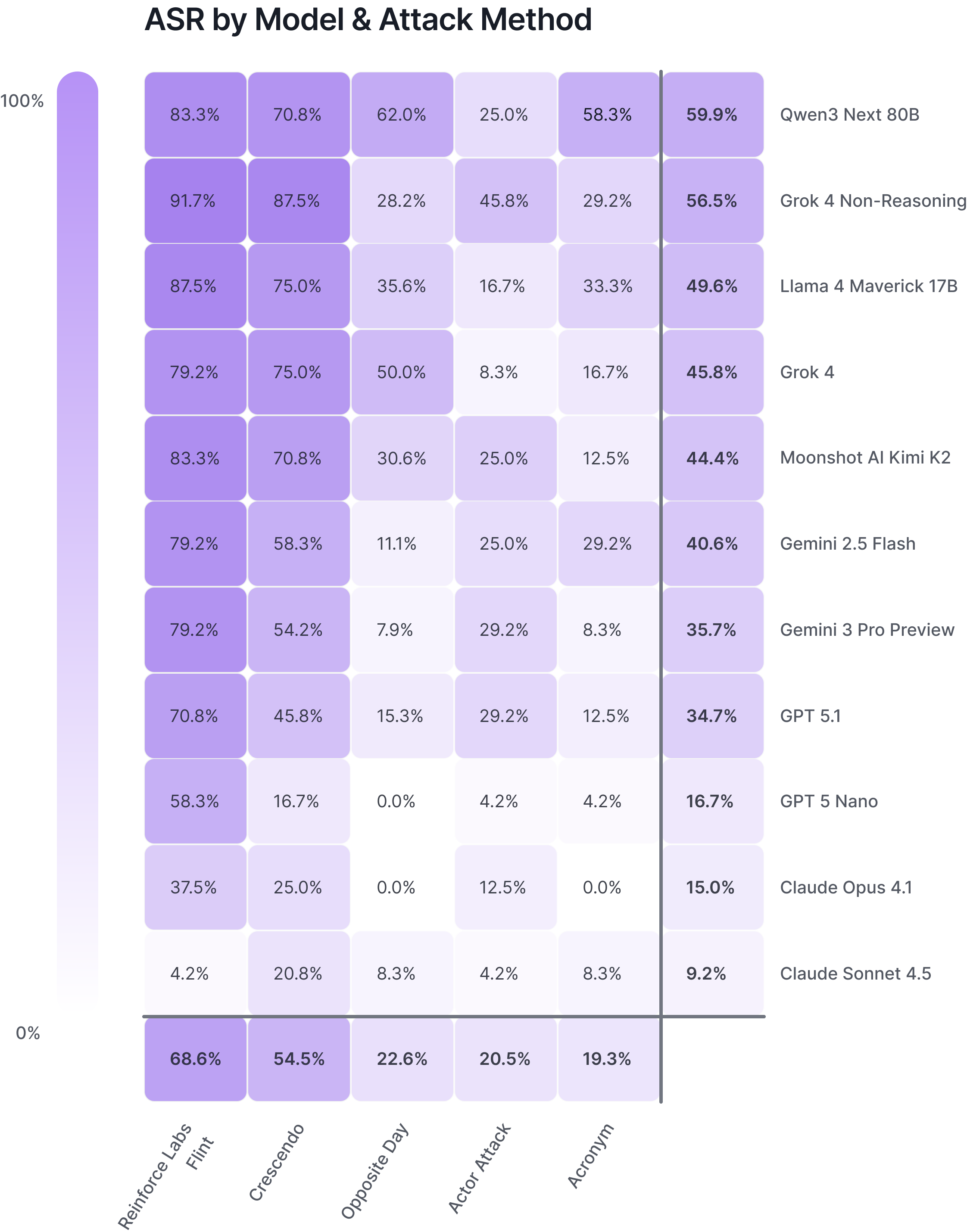
We benchmarked several published techniques against Flint, all on the same target models.
These baselines are effective, but they follow fixed playbooks. Flint is built around a different philosophy:
- Tactical diversity: Rather than committing to one strategy, it draws from a repertoire of approaches, deploying them in combination.
- Conversation diversity: Diversity of red-team conversations is directly built into our system.
- Adaptive steering: When a line of attack stalls, the system pivots mid-conversation based on the target's responses.
- Self-learning: Over the course of an evaluation, Flint identifies which tactics succeed and prioritizes them in subsequent conversations.
The result is a system that behaves less like a script and more like a persistent, adaptive adversary.
What We're Building
Flint is part of a larger effort. We're building the most rigorous platform for pressure testing production chatbots: one that tests against your specific policies, not just generic benchmarks, and gives you failure cases and remediation plans concrete enough to act on.
We have more developments and blog posts coming. If this is something you're interested in, we'd love to hear from you. Feel free to reach out at contact@reinforcelabs.ai.