
Egocentric manipulation from real production floors
egocentric-manipulationFirst-person video of skilled manual work captured on real factory and workshop floors, each clip densely annotated with 21-keypoint hand pose for both hands, hand-visibility state, per-hand detection confidence, and frame-accurate contact and release events. Built for the embodied models that learn manipulation from how people actually use their hands.
First example
taskBimanual disc finishing — one hand holds a metal disc against the fixture while the other drives an abrasive tool across its face, including the brief release moment where both hands leave the workpiece.
Expressive speech across tone, accent, and identity
expressive-speech-safetyRecorded and synthetic speech annotated along the dimensions that matter for audio models: emotional tone and prosody, regional and non-native accents, speaker identity with paired real and cloned voices for impersonation detection, scenario intent including fraud and social-engineering red-team content, code-switching, and acoustic environment. Every clip ships with a verified transcript and per-dimension labels.
First example
scenarioVoice-clone impersonation of a public figure delivering a cryptocurrency giveaway pitch — a negative example for training and evaluating audio deepfake and scam-call detectors.
Step-verified derivations for scientific reasoning
verified-reasoning-tracesGraduate-level physics and STEM problems paired with complete, step-checked reasoning traces: explicit givens, a numbered derivation with every intermediate value verified, a unique machine-checkable answer, and an independent sanity check. Items that reduce to one-line arithmetic, leak the answer in the prompt, or whose derivation doesn't land on the stated answer are filtered out in QA.
First example
With b₀ = 11 − (2/3)n_f and leading-order running 1/α_s(Q) = 1/α_s(M_Z) + (b₀/2π)·ln(Q/M_Z), evaluate α_s at Q = 500 GeV. Report to two decimal places.
givenα_s(M_Z) = 0.118 M_Z = 91.2 GeV Q = 500 GeV n_f = 5
1 · Beta-function coefficient: b₀ = 11 − (2/3)(5) = 23/3 ≈ 7.667 2 · Invert the coupling: 1/α_s(M_Z) = 1/0.118 = 8.475 3 · Running coefficient: b₀/(2π) = 7.667 / 6.2832 = 1.220 4 · Energy logarithm: ln(Q/M_Z) = ln(500/91.2) = ln(5.482) = 1.702 5 · Evolve the inverse coupling: 1/α_s(Q) = 8.475 + (1.220)(1.702) = 10.551 6 · Invert back: α_s(500 GeV) = 1/10.551 = 0.0948, rounded to two decimals.
sanity checkCoupling fell from 0.118 → 0.095 as energy rose — the correct direction for asymptotic freedom, confirming the sign convention was applied right.
Longitudinal EHR and clinical conversations at population scale
longitudinal-ehrLongitudinal electronic health records spanning visits, diagnoses, medications, and lab series, shipped as verified reasoning tasks over the raw records: multi-hop temporal QA, clinical entity extraction, and longitudinal aggregation, each with a step-by-step evidence-grounded trace, a programmatically checked gold answer, and label-quality flags. Alongside the records: 6,000+ hours of doctor-patient conversations with transcripts available on demand. All datasets can be structured, filtered, de-identified, annotated, and quality-reviewed to the partner's use case, specialty, language, modality, and compliance requirements.
First example
qRosuvastatin was newly initiated for this patient at one visit (medicine_status = 'entry'). What was the change in LDL cholesterol from the last reading before that visit to the first reading after it? Report the initiation date, both readings, and the absolute change in mg/dL.
1 · locate_medication_event — scan medication records for rosuvastatin with status = 'entry'. Initiation visit = V00214, dated 2025-04-02. 2 · partition_lab_series — sort the LDL series and split around 2025-04-02. Last before: 120 mg/dL (2025-03-31). First after: 65 mg/dL (2025-05-17). 3 · compute_delta — 65 − 120 = −55 mg/dL (−45.8% relative change). 4 · sanity_check — a high-intensity statin (rosuvastatin 40 mg) initiation is typically followed by a large LDL drop within 4–6 weeks; the 46-day gap fits. Answer accepted.
verificationProgrammatic exact match — recompute from source JSON: filter meds by (generic~rosuvastatin, status=entry); partition sorted LDL readings around visit_date; assert delta == −55.0.
quality flagSame visit V00214 maps raw text 'kco ald with old pancreatitis' to diagnosis 'adrenoleukodystrophy'; clinical context (pancreatitis, Indian shorthand) strongly suggests 'alcoholic liver disease'. Ontology-mapping defect — excluded from this task's context but relevant for dataset QA.
Verifiable reasoning at scale
Non-trivial undergraduate and early-graduate problems with single, machine-verifiable answers. Broad coverage across algebra, combinatorics, geometry, topology, number theory, probability, optimization, graph theory, and analysis. The workhorse corpus for reasoning RL and supervised fine-tuning.
First example
Let be the set consisting of together with all complex roots of . How many monic degree- complex polynomials have eight distinct roots, all lying in , with the additional property that every root is a corner point of the convex hull of the eight roots in the complex plane?
Curated to break frontier models
undergrad-frontier-breakingUndergraduate-level tasks specifically engineered to defeat frontier models. Every item is benchmarked against strong models and kept only if they fail to solve it, giving you dense, high-signal training and eval material without crossing into graduate research.
First example
The complete graph on labeled vertices has spanning trees by Cayley's formula. Determine the number of spanning trees in which, for every edge, the sum of the degrees (in the tree) of its endpoints is at most .
Frontier-grade difficulty
graduate-frontier-breakingGraduate and research-style tasks designed to challenge frontier models. The hardest tier we ship, sourced from advanced coursework and research-adjacent problems, then benchmarked against the strongest available models to confirm genuine frontier difficulty.
First example
Work over with basis and alternating form . Let be the set of incident pairs , where is a 1-dimensional subspace of and is a 2-dimensional subspace containing on which this form is identically zero. Let be the -vector space of all labelings such that, for every , the sum of over all containing is 0 in , and for every , the sum of over all contained in is 0 in . With denoting the matrix in row and column , define , , , and for in . Let be the -dimension of the part of fixed by every and , and define similarly using and . Let be the index, among projective linear transformations preserving the incidence relation on , of those induced by matrices preserving the alternating form exactly. The reported score is if is congruent to modulo 3 and the two numbers have opposite parity; otherwise the reported score is 0. What is the reported score?
Informal to formal, fully proved
Lean 4 data drawn from the undergraduate and graduate difficulty bands. Each record pairs a natural-language statement with its Lean formal statement and a complete, type-checked Lean proof, exactly what you need to train and evaluate autoformalization and proof-synthesis models.
First example
The sum of two even integers is even.
lean statementtheorem even_add_even (m n : ℤ) (hm : Even m) (hn : Even n) : Even (m + n)proof
theorem even_add_even (m n : ℤ) (hm : Even m) (hn : Even n) :
    Even (m + n) := by
  obtain ⟨a, ha⟩ := hm
  obtain ⟨b, hb⟩ := hn
exact ⟨a + b, by rw [ha, hb]; ring⟩Multimodal quantitative reasoning
Real-world charts across finance, healthcare, government, education, and scientific research, each paired with a grounded, verifiable question, a gold answer, and a full step-by-step chain of thought. Questions demand reading exact values, multi-step computation, and cross-panel reasoning, built for multimodal reasoning models.
First example
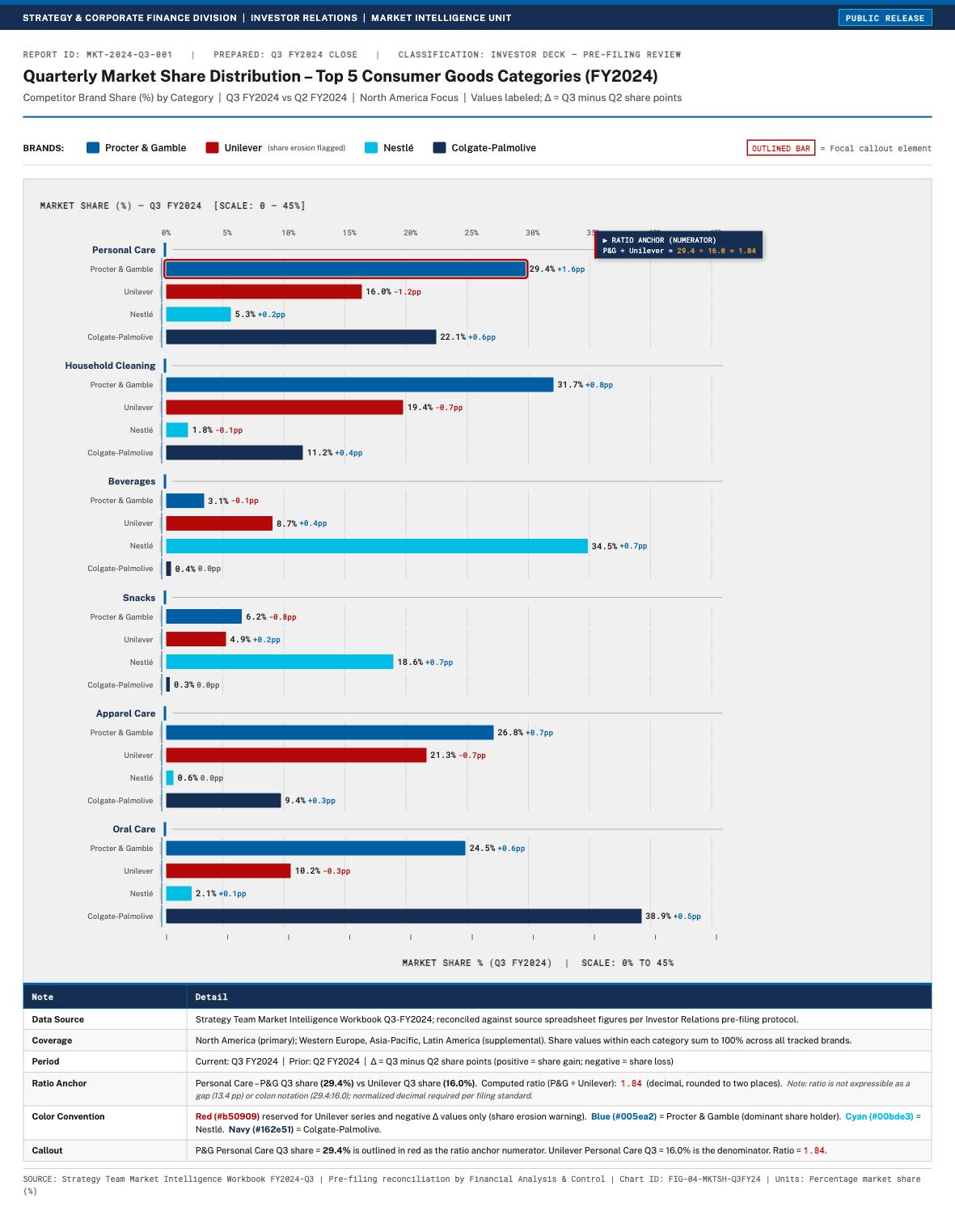
qWhat is the difference between Unilever's and Colgate-Palmolive's market share in Apparel Care, and which brand's delta suggests it is closing the gap faster?
Unilever holds 21.3% share in Apparel Care (delta -0.7pp, share erosion flagged) versus Colgate-Palmolive's 9.4% (delta +0.3pp). The gap is 21.3 - 9.4 = 11.9 percentage points. With Unilever eroding 0.7pp and Colgate-Palmolive gaining 0.3pp, the gap narrows at a combined 1.0pp per quarter, and Unilever's erosion is the dominant factor closing it.
Reason over maps and geospatial layers
Real cartographic maps spanning land cover, hydrology and flood risk, terrain elevation, and urban transportation, each paired with a grounded, verifiable question, a gold answer, and a full chain of thought. Questions require reading legends, scale bars, contour spacing, and choropleth gradients, then performing multi-layer spatial inference, built for multimodal models that need to reason over geospatial data.
First example
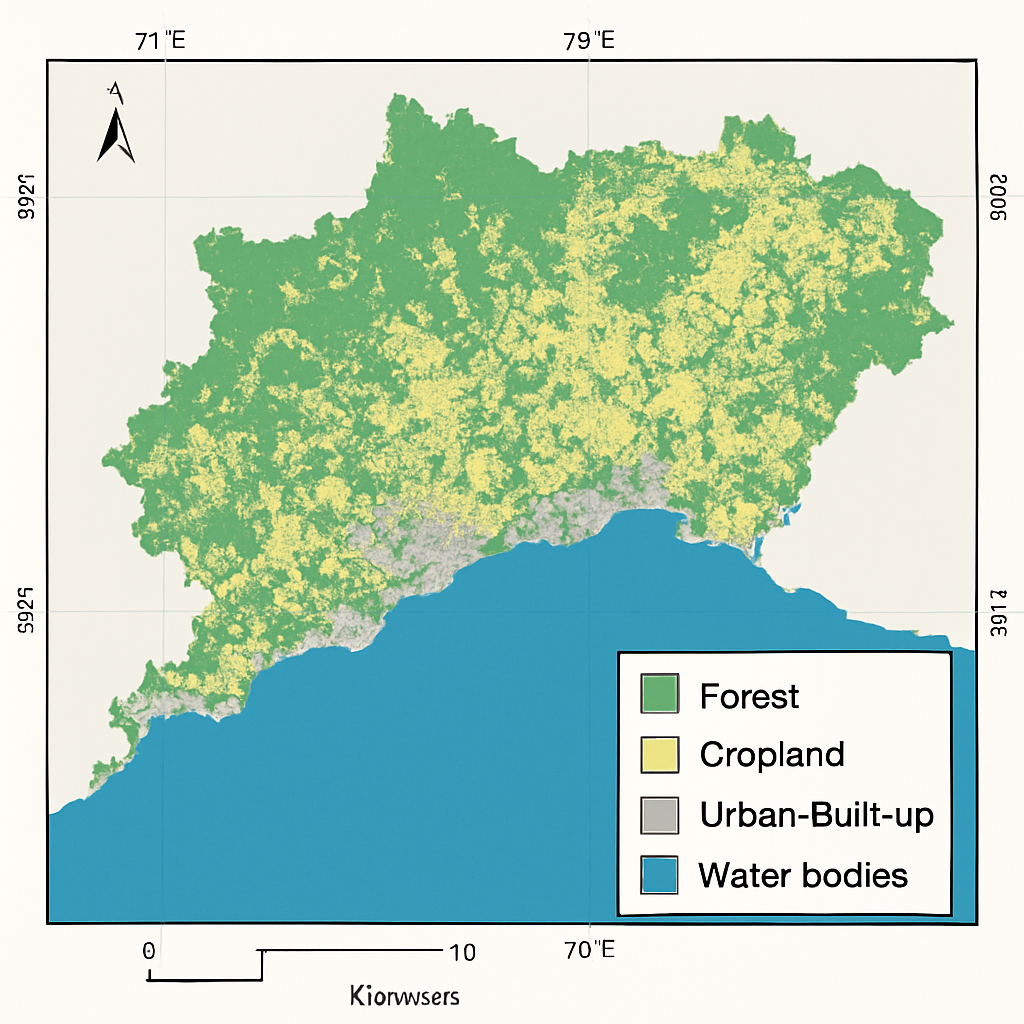
qUsing the land-cover classification, which class occupies the largest contiguous area along the coastline, and what is the dominant adjacency relationship between urban (gray) and water (blue) classes?
Reading the legend, green = forest, gray = urban, blue = water. Tracing contiguous polygons along the coast, the green forest class forms the largest unbroken band inland of the shore. The gray urban polygons consistently border the blue water class at the estuary mouth rather than being embedded inland, which is the classic signature of a port settlement that grew around a harbor. Cropland (yellow) sits behind the urban fringe, away from the immediate shoreline.
Quality is the product. Each corpus is built to be hard, clean, and machine-gradable from day one.
Problems are drawn and authored across nine mathematical domains, spanning undergraduate coursework to research-adjacent material, never scraped boilerplate.
Hard tiers are tested against the strongest available models first. Any problem they solve gets dropped, so what's left is the dense, high-signal material that actually moves evals.
Math ships with single checkable answers, Lean ships with type-checked proofs, and chart QA is grounded in the underlying data, so grading is unambiguous.
Our core team comes from mathematics and computer science at the University of Pennsylvania, with access to a broader network of PhDs, postdocs, and faculty across technical fields. The data is written and reviewed by people who understand the mathematics, not scraped from public problem banks or lightly rewritten from competitions.
Tell us the domains, difficulty band, and volume you need. We'll send representative samples and a quote. Bulk and exclusive licensing available.